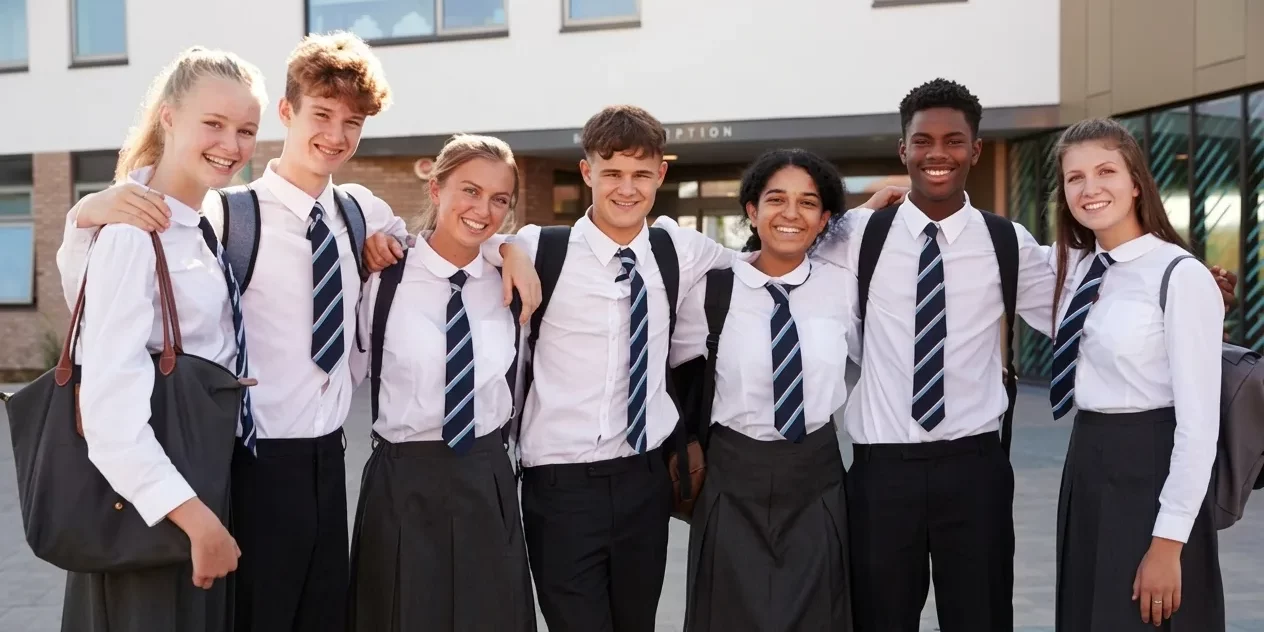

For school owners and parents exploring the social sciences stream within the Ontario Secondary School Diploma, HSB4U is a course that deserves careful attention. Officially titled Challenge and Change in Society, it draws on psychology, sociology and anthropology to help students understand how human behaviour shapes, and is shaped by, the world around them. Whether you are a school leader weighing an OSSD partnership or a parent guiding a student toward university, this guide explains what the course covers, who it is designed for, and why it matters for post-secondary success.
What HSB4U Covers: Psychology, Sociology and Anthropology
HSB4U is the Ontario Ministry of Education course code for Challenge and Change in Society, Grade 12, University Preparation. It carries a credit value of 1.0 and falls within the Social Sciences and Humanities curriculum, as outlined in the Ontario Curriculum, Grades 9 to 12, 2013 (Revised).
At its core, the course is an interdisciplinary study of human behaviour. Students investigate how knowledge, attitudes, beliefs and behavioural patterns shift over time, and they do so through the combined lenses of three social science disciplines. In psychology, students explore theories of individual behaviour, cognition, motivation and development. In sociology, they examine social structures, institutions, group dynamics and the forces that hold communities together or drive them apart. In anthropology, they study culture: how cultural identities are formed, maintained and transformed, and how cross-cultural comparisons reveal both shared human experiences and meaningful differences.
The curriculum moves through several connected areas of study. Students begin by building foundational knowledge in social science perspectives and research methods, including the social science inquiry model and APA-style academic reporting. From there, the course progresses into the causes and effects of social change, examining how influential leaders, conformity, alienation, poverty, affluence and technology each play a role in shaping societies. Students then analyse social patterns and trends, including Canadian demographics, identity formation, youth culture and deviance. The final strand addresses global issues, where students evaluate the impact of globalization, social inequality and the exploitation of people and resources on both local and international scales.
Throughout every unit, the emphasis is on critical analysis, not memorization. Students apply social science theories and research methodologies to real-world issues, developing the capacity to think rigorously about human behaviour in all its complexity. This is precisely the kind of higher-order thinking that universities value in incoming applicants.
Prerequisites and Who the Course Suits
The official Ontario prerequisite for HSB4U is any university (U) or university/college (M) preparation course in Social Sciences and Humanities, English, or Canadian and World Studies. In practical terms, many students enter HSB4U after completing HSP3U (Introduction to Anthropology, Psychology and Sociology) in Grade 11, though the prerequisite framework is intentionally broad to accommodate a range of academic backgrounds.
This flexibility is worth noting for school owners designing course pathways. Because HSB4U accepts a wider pool of prerequisite courses than most Grade 12 U credits, it is accessible to students who may not have followed a strict social sciences track from Grade 9. A student who has completed a Grade 11 or 12 U or M course in English or Canadian and World Studies is eligible to enrol.
That said, a word of honest guidance for parents: while the prerequisite is broad, the course itself is rigorous. Students are expected to read and evaluate academic research, construct arguments using social science theories, and write in a structured, evidence-based style. Those who enter with strong reading comprehension, an interest in current events and a willingness to engage with complex questions about society will find the course both manageable and rewarding. Students who prefer clear-cut answers may find the open-ended, analytical nature of social science inquiry more challenging than anticipated.
On workload, as with other Grade 12 U courses in Ontario, approximately 70% of the final grade comes from ongoing coursework, including assignments, research projects, case studies and tests. The remaining 30% is determined by a culminating activity or final examination. Consistent engagement throughout the term is essential, as each unit builds on concepts introduced earlier.
HSB4U for Social Science and Psychology Applicants
For students considering university programmes in psychology, sociology, social work, criminology, education, public policy, law or international development, HSB4U provides a direct and meaningful academic foundation. While it is not always listed as a mandatory admission requirement in the way that MHF4U is required for engineering, HSB4U frequently appears as a recommended or preferred course for humanities and social science programmes. More importantly, it provides the kind of disciplinary grounding that prepares students to succeed once they arrive on campus.
University-level social science programmes expect incoming students to understand fundamental concepts such as socialization, social stratification, cultural relativism and research ethics. HSB4U introduces all of these at a level of depth that creates a genuine academic advantage in first-year studies. Students who have completed the course arrive at university already familiar with the inquiry process, theoretical frameworks and writing conventions that their professors will expect from the start.
For school owners, offering HSB4U alongside courses like ENG4U within the social sciences and humanities stream creates a coherent and attractive pathway for students whose strengths and interests lie outside STEM. This broadens the school’s appeal and enables more students to build a Grade 12 course selection that aligns with their post-secondary goals. For parents, the takeaway is equally clear: if your child is drawn to understanding people, communities and the forces behind social change, HSB4U is the course that transforms that curiosity into a university-ready skill set.
FAQ for HSB4U, OSSD and Rosedale Edu
What is HSB4U?
HSB4U is the Ontario Ministry of Education course code for Challenge and Change in Society, a Grade 12, University Preparation course within the Social Sciences and Humanities curriculum. It carries a credit value of 1.0 and explores human behaviour through the disciplines of psychology, sociology and anthropology.
What is the prerequisite for HSB4U?
Any university (U) or university/college (M) preparation course in Social Sciences and Humanities, English, or Canadian and World Studies at the Grade 11 or 12 level.
Is HSB4U required for university?
It depends on the programme. HSB4U is recommended or preferred for many social science, psychology, criminology and education programmes. Even when it is not a strict requirement, it provides foundational knowledge that supports success in university-level humanities and social science courses.
How does Rosedale deliver HSB4U?
Rosedale Global High School offers HSB4U as part of its OSSD course portfolio of more than 50 courses. Through Rosedale’s innovative collaboration model, students study locally at an international partner school while earning the globally recognised Ontario Secondary School Diploma, supported by Rosedale’s digital learning platform, data-driven learning management and centralised OSSD academic administration.
Can our school offer HSB4U through Rosedale?
Yes. Rosedale partners with international schools to deliver and customise OSSD programming, including Challenge and Change in Society, while your institution retains its local teaching expertise.
Partner with Rosedale to Deliver OSSD, Including HSB4U
HSB4U is more than a social science credit. It is a course that equips students with the critical thinking, research skills and cross-cultural awareness that universities and employers increasingly demand. Delivering it well requires a proven curriculum, robust academic administration, and the technology and quality assurance to back it up.
That is precisely what Rosedale Global High School brings to its partner schools. With 62 Global High School partners across 17 countries and a curriculum grounded in the Ontario Secondary School Diploma, Rosedale empowers international partner schools to offer world-recognised OSSD programming, from Challenge and Change in Society to a full portfolio of over 50 courses, while centrally managing academic administration to ensure consistent excellence. Students graduate with the globally recognised OSSD and apply to universities worldwide as Ontario high school graduates.
If you are a school owner ready to expand your students’ university pathways, or a parent seeking a school that delivers the OSSD with genuine rigour, we invite you to take the next step. Contact Rosedale International Education to explore an OSSD partnership and bring courses like HSB4U to your students.