
Artificial intelligence is no longer a distant promise for the education sector. It is already here, quietly reshaping how teachers deliver lessons, how students absorb knowledge, and how institutions operate behind the scenes. From adaptive learning platforms that adjust to each student’s pace to intelligent systems that automate administrative burdens, AI in education has moved from experimental pilot programs to everyday classroom reality.
The shift is significant. UNESCO published its first Guidance for Generative AI in Education and Research in September 2023, followed by dedicated AI competency frameworks for both teachers and students in 2024. The European Union’s AI Act, formally adopted in 2024 with phased implementation running through 2026 and 2027, now classifies AI used in education access and assessment as high risk. These developments signal that the conversation has matured from speculation into structured policy.
For school owners, academic directors, and education leaders, the question is no longer whether AI belongs in the classroom. The real question is how to integrate it responsibly, effectively, and in alignment with institutional values. As global EdTech spending is projected to exceed $400 billion in 2026, institutions that fail to engage with AI risk falling behind their peers and losing relevance among families seeking forward-thinking education for their children.
This article explores the core applications of AI in education, examines how schools and universities worldwide are adopting these technologies, and addresses the ethical considerations that every education leader must weigh carefully. Whether you are a school owner evaluating new technologies or a parent researching the best learning environment for your child, understanding AI’s role in modern education is essential.
Key Applications: Personalized Learning, Assessment Automation, and Intelligent Tutoring
The practical applications of AI in education can be grouped into three major categories that directly impact teaching and learning outcomes.
Personalized Learning at Scale
One of the most transformative applications of AI is personalized learning. Traditional classrooms require teachers to deliver the same content to every student at the same pace, regardless of individual strengths and gaps. AI-powered adaptive learning platforms change this dynamic entirely. These systems analyze each student’s performance in real time and adjust the content, difficulty level, and learning pathway accordingly.
For school leaders considering a new school programme accreditation pathway or evaluating existing curricula, the integration of personalized learning tools can serve as a key differentiator. Families increasingly look for institutions that tailor the learning experience to individual student needs rather than applying a one-size-fits-all approach.
Assessment Automation and Data-Driven Insights
AI is also transforming how schools assess student progress. Generative AI tools now assist educators in creating question banks, designing rubrics, and even providing preliminary feedback on student work. This does not replace teacher judgment. Instead, it frees up valuable time so that educators can focus on higher-order tasks such as mentoring, lesson planning, and student engagement.
Beyond grading, AI analytics platforms give school administrators access to institutional performance dashboards. These tools identify patterns in student achievement, flag at-risk learners early, and provide data-driven recommendations for curriculum improvement. For institutions undergoing programme accreditation for schools, these analytics can streamline the evidence-gathering process and demonstrate measurable learning outcomes to accrediting bodies.
Intelligent Tutoring Systems
Intelligent tutoring systems represent another significant advancement. These AI-powered platforms simulate one-on-one tutoring experiences by responding to student queries, providing hints, and guiding learners through complex problems step by step. Unlike static textbook exercises, intelligent tutors adapt their approach based on how the student interacts with the material.
These systems are particularly valuable for schools operating across multiple time zones or serving diverse student populations with varying levels of language proficiency. They provide additional learning support outside regular classroom hours without requiring schools to hire extra staff.
How Schools and Universities Are Adopting AI Worldwide
AI adoption in education is not limited to a single region or school type. It is a global movement driven by institutional ambition, government policy, and growing demand from families.
In North America, schools are integrating AI tools for lesson planning, student assessment, and administrative efficiency. The Ontario Secondary School Diploma (OSSD) curriculum, for example, has long emphasized competency-based and differentiated education. Schools delivering the OSSD internationally through partnership models are already leveraging digital learning platforms enhanced by AI to support students across borders and time zones.
In Europe, the regulatory landscape is shaping adoption. The EU AI Act has introduced a classification system for AI risk levels, and educational institutions are adjusting their practices accordingly. Schools in the United Kingdom, Germany, and the Netherlands are piloting AI-driven assessment tools while ensuring compliance with data protection regulations.
Across Asia Pacific, adoption has been particularly strong. Countries such as Singapore, China, and Australia have invested heavily in AI literacy programs for both teachers and students. Universities in these regions are collaborating with EdTech providers to embed AI into core curricula, moving beyond extracurricular experimentation.
In the Middle East and Africa, UNESCO regional offices are mapping how AI is being implemented across education systems and developing guidance for school leaders on responsible AI integration. The Gulf States have emerged as pioneers in this space, with government-backed initiatives supporting AI readiness across K-12 institutions.
What unites these global efforts is a shared recognition that AI is not a replacement for teachers. It is a tool that amplifies what great educators already do. For school leaders evaluating how to verify programme accreditation in a rapidly changing landscape, understanding how peer institutions worldwide are adopting AI can inform strategic planning and curriculum development decisions.
Challenges and Ethical Considerations of AI in Education
Despite its promise, AI in education comes with challenges that institutions must address thoughtfully.
Data Privacy and Student Protection
AI systems require data to function effectively. In an educational context, this means collecting and processing sensitive information about students, including learning behaviors, performance patterns, and sometimes personal details. Schools must ensure that any AI tool they adopt complies with local and international data protection regulations. Families expect that their children’s data will be handled responsibly, and institutions that fail to uphold this trust risk reputational damage and legal consequences.
Equity and Access
The digital divide remains a significant concern. While schools in well-resourced regions benefit from cutting-edge AI tools, many institutions in developing countries still lack basic internet connectivity. UNESCO has noted that approximately 1 in 4 primary schools worldwide has no access to electricity, and 60% are not connected to the internet. AI-driven education innovation must be accompanied by investment in foundational digital infrastructure to avoid widening existing inequalities.
Teacher Training and Readiness
AI tools are only as effective as the educators who deploy them. UNESCO released its AI Competency Framework for Teachers in August 2024, providing the first structured guidance on the technical, ethical, and pedagogical competencies that teachers need to integrate AI responsibly. Schools investing in AI must also invest in professional development to ensure that teachers feel confident and supported.
Algorithmic Bias and Transparency
AI systems are trained on data, and that data can carry biases. If left unchecked, these biases can influence student assessments, recommendations, and learning pathways in ways that disadvantage certain groups. Schools must demand transparency from AI vendors about how their algorithms work and what safeguards are in place to prevent discriminatory outcomes.
For institutions navigating accredited school programme meaning and standards, integrating AI responsibly is now part of the accreditation conversation. Accrediting bodies increasingly expect schools to demonstrate not only academic quality but also ethical technology governance.
Frequently Asked Questions About AI in Education and the Global Education Innovation Summit 2026
What is AI in education?
AI in education refers to the application of artificial intelligence technologies to enhance teaching, learning, and institutional operations. This includes personalized learning platforms, automated assessment tools, intelligent tutoring systems, and data analytics dashboards that help educators make informed decisions about student outcomes.
How is AI changing the role of teachers?
AI is not replacing teachers. It is augmenting their capabilities. By automating routine tasks such as grading, attendance tracking, and lesson resource generation, AI allows teachers to focus on what they do best: mentoring students, facilitating discussions, and providing the human connection that technology cannot replicate.
What is the Global Education Innovation Summit?
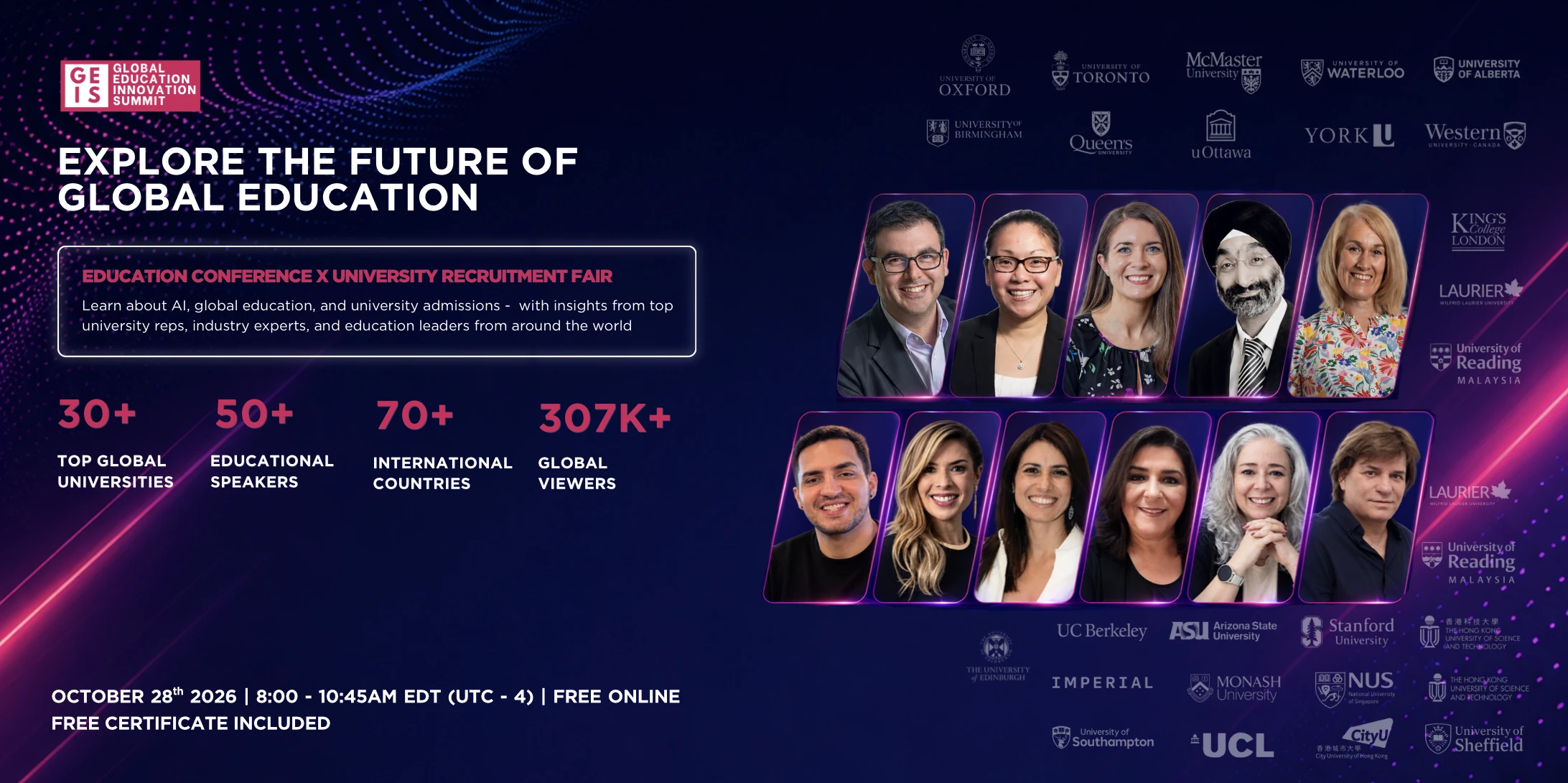
The Global Education Innovation Summit (GEIS) is a live virtual event hosted by Rosedale International Education on October 28, 2026. The summit brings together 30+ global speakers, 40+ world-class university representatives, and education leaders from 72+ countries. It features sessions on AI in education, global admissions, K-12 to higher education pathways, and innovation in educational technology. Registration is free at this link.
Who should attend the Global Education Innovation Summit?
GEIS is designed for educators, school administrators, academic directors, parents, students, and EdTech professionals. School leaders can discover strategies for institutional transformation and explore pathways to international curriculum adoption. Parents and students can meet university representatives from institutions such as Oxford, Imperial College London, University of Toronto, and many more.
What does school programme accreditation mean, and why does it matter?
School programme accreditation is the process by which an independent authority evaluates and certifies that a school’s educational programme meets established quality standards. An accredited school programme means that the institution has undergone rigorous peer review and that its graduates hold qualifications recognized by universities and employers worldwide. For families, it is one of the most reliable indicators of educational quality.
How can I verify programme accreditation for a school?
To verify programme accreditation, check whether the school is listed with a recognized accrediting body such as the Council of International Schools (CIS), the New England Association of Schools and Colleges (NEASC), or a government education authority. For schools offering the OSSD, verification can be done through the Ontario Ministry of Education’s records. Attending events such as GEIS can also help parents and school leaders connect with accredited institutions and ask questions directly.
Prepare Your School for the Future of Education with Rosedale
The integration of AI in education is accelerating, and schools that position themselves at the forefront of this transformation will attract families, educators, and partners who value innovation and academic excellence.
Rosedale International Education is a global education and technology provider that partners with international schools to co-deliver the Ontario Secondary School Diploma (OSSD) curriculum. With a network spanning 100+ partner schools across more than 17 countries, Rosedale provides a comprehensive solution that includes a transformative curriculum, an integrated digital learning platform, and quality assurance services designed to support schools in delivering world-class education.
The OSSD is internationally recognized as a leader in differentiated, competency-based education. It is verified by PISA (Programme for International Student Assessment) as ranking among the top high school programmes globally. For school owners and academic directors seeking an accredited school programme that equips students for admission to leading universities worldwide, partnering with Rosedale offers a proven, scalable pathway.
To learn more about how AI and innovation are shaping the future of global education, register for the Global Education Innovation Summit 2026 on October 28, 2026. Connect with 30+ global speakers, meet representatives from 40+ world-class universities, and discover strategies for institutional transformation. Register for free now!