
Artificial intelligence is no longer a distant concept reserved for technology companies and research labs. In classrooms around the world, AI in teaching has become a practical tool that helps educators design better lessons, assess student progress more effectively, and invest in their own professional growth. For school owners, academic directors, and parents who are evaluating learning programs, understanding how teachers use AI is now essential to making informed decisions about education quality.
Whether you lead an international school looking for innovative curriculum solutions or you are a parent seeking programs that prepare students for the future, the integration of artificial intelligence for teachers represents a shift in how instruction is delivered and how learning outcomes are achieved. This article explores the most significant ways AI is transforming teaching practice today, and why these developments matter for the future of global education.
The Role of AI in Modern Teaching Practice
The conversation around AI in education has moved well beyond theory. By 2026, AI tutoring systems, automated assessment tools, personalized learning platforms, and AI-assisted content creation have transitioned from experimental pilots to mainstream adoption across K-12 and higher education institutions worldwide.
For educators, artificial intelligence for teaching serves as a force multiplier. Rather than replacing the teacher, AI handles the repetitive and time-consuming tasks that often prevent educators from focusing on what matters most: mentorship, critical thinking development, and meaningful student engagement. Research consistently shows that AI tools are most effective when they augment teacher expertise rather than substitute for pedagogical judgment.
This is a significant development for school leaders. Institutions that embrace AI-enabled teaching practices can offer more responsive and personalized instruction to their students, which in turn strengthens their competitive position in an increasingly global education market. The role of the teacher is evolving from “primary information source” to “learning architect,” a professional who designs, facilitates, and refines learning experiences with the support of intelligent tools.
For parents, this shift means that schools integrating AI for teachers are better positioned to deliver instruction that meets each student where they are, adapting to individual learning needs in ways that were previously impossible at scale.
AI-Powered Lesson Planning, Curriculum Design, and Content Curation
One of the most immediate and practical applications of AI in teaching is lesson planning. Traditionally, creating a well-structured lesson plan requires hours of research, alignment to curriculum standards, differentiation for diverse learners, and the selection of appropriate instructional materials. AI-powered tools now streamline this entire process.
Modern AI lesson planning platforms allow teachers to input a topic, grade level, and learning objectives, and then generate a complete interactive lesson within minutes. These tools can align lesson plans with national or international curriculum standards, suggest differentiated activities for students at different proficiency levels, and recommend supplementary resources such as videos, readings, and interactive exercises.
Beyond lesson creation, AI also supports curriculum design at the institutional level. School leaders can use AI to analyze learning outcome data across classrooms, identify gaps in curriculum coverage, and ensure that instructional sequences build upon one another in a logical and standards-aligned progression. This level of data-driven curriculum planning was once available only to large school systems with dedicated research teams. AI has made it accessible to individual schools and smaller networks.
Content curation is another area where AI delivers significant value. Teachers AI tools can scan vast libraries of educational resources and surface the most relevant, high-quality materials for a specific lesson or unit. This saves educators from the often overwhelming task of sifting through countless online resources and ensures that the content students engage with is current, credible, and pedagogically appropriate.
For school owners considering new curriculum partnerships, AI-enabled lesson planning and curriculum design capabilities are strong indicators of a forward-thinking program that prioritizes both instructional quality and teacher efficiency.
AI for Assessment: Automated Grading, Rubrics, and Feedback
Assessment is one of the most time-intensive responsibilities in teaching. Grading assignments, designing rubrics, and providing meaningful feedback to every student can consume a significant portion of an educator’s working hours. This is where artificial intelligence for teachers is making a measurable impact.
Automated grading systems powered by AI can evaluate student responses with a level of consistency that is difficult to maintain through manual review. For objective assessments such as multiple-choice tests, short-answer questions, and structured exercises, AI grading tools deliver instant results while eliminating the subjective biases that can arise during human evaluation.
More advanced applications extend to essay and open-response assessment. AI tools can analyze student writing for structure, coherence, grammar, and alignment with rubric criteria, then generate detailed feedback that highlights both strengths and areas for improvement. Studies on AI-enabled assessment tools have shown improvements in learning outcomes, largely because students receive timely and actionable feedback rather than waiting days or weeks for a graded assignment.
AI-generated rubrics are another notable development. Teachers can specify learning objectives, assignment parameters, and performance expectations, and AI tools produce structured rubrics that are aligned to those criteria. Research involving K-12 teachers has found that AI-generated rubrics are generally well-received, though educators emphasize the importance of reviewing and refining them to ensure they reflect the nuances of their specific classroom context.
Critically, AI in assessment does not remove the teacher from the process. The most effective implementations use a hybrid approach in which AI handles the initial evaluation and feedback generation, while the teacher reviews, adjusts, and contextualizes the results. This model reduces teacher workload without sacrificing the professional judgment that effective assessment requires.
For school leaders and parents alike, institutions that use AI-supported assessment practices demonstrate a commitment to both efficiency and educational rigor, ensuring that students receive consistent, high-quality feedback that accelerates their learning.
Professional Development: How Teachers Can Build AI Literacy
As AI becomes increasingly embedded in classroom practice, the question of teacher preparedness has moved to the forefront of education policy and institutional planning. The UNESCO AI Competency Framework for Teachers, released in 2024, identifies fifteen competencies across five key areas that educators need to develop, progressing through three levels: Acquire, Deepen, and Create. In 2026, the European Commission and the OECD released their AI Literacy Framework, which organizes AI literacy into four domains: Engage, Create, Manage, and Shape AI.
These frameworks share a common message. AI literacy for teachers is not simply about learning to operate specific software tools. It encompasses ethical awareness, pedagogical integration, data literacy, and the ability to critically evaluate AI-generated outputs. Teachers who build strong AI literacy are better equipped to use these tools responsibly and to guide their students in doing the same.
Practical professional development in AI for teachers typically includes hands-on workshops where educators practice using AI platforms for lesson planning, assessment design, and personalized learning. Effective training programs also address prompt engineering, which is the skill of communicating clearly and precisely with AI tools to produce the most useful outputs. Additionally, professional development sessions increasingly cover the ethical dimensions of AI use in education, including data privacy, algorithmic bias, and the importance of maintaining human oversight in all AI-assisted processes.
For school owners and administrators, investing in AI professional development for teaching staff is not optional. It is a strategic priority. Schools that equip their teachers with AI competencies position themselves as leaders in educational innovation, which is a compelling differentiator when attracting partner institutions, students, and families.
The good news is that educators do not need to become technologists. The goal of artificial intelligence for teaching is to make teachers more effective at what they already do best: inspire, guide, and support learners. AI literacy simply ensures they can do so with the most powerful tools available.
Frequently Asked Questions About AI in Teaching and the Global Education Innovation Summit 2026
What is AI in teaching?
AI in teaching refers to the use of artificial intelligence tools and technologies to support and enhance the instructional process. This includes AI-powered lesson planning, automated grading and feedback, personalized learning platforms, content curation, and data-driven curriculum design. The goal is not to replace teachers but to augment their capabilities, allowing educators to focus on high-value human interactions such as mentorship, creativity, and critical thinking development.
Will AI replace teachers?
No. Artificial intelligence for teachers is designed to handle routine and administrative tasks such as grading, scheduling, and resource gathering. The qualities that define excellent teaching, including emotional intelligence, mentorship, cultural sensitivity, and the ability to inspire, remain fundamentally human. AI is a tool that empowers educators to be more effective, not a substitute for the teacher-student relationship.
How can school owners benefit from AI integration?
School owners who adopt AI-enabled teaching practices can improve instructional quality, reduce teacher workload, and differentiate their institutions in a competitive education market. AI supports data-driven decision-making at the institutional level, from curriculum planning to student performance analysis, helping schools deliver measurable learning outcomes.
What is the Global Education Innovation Summit 2026?
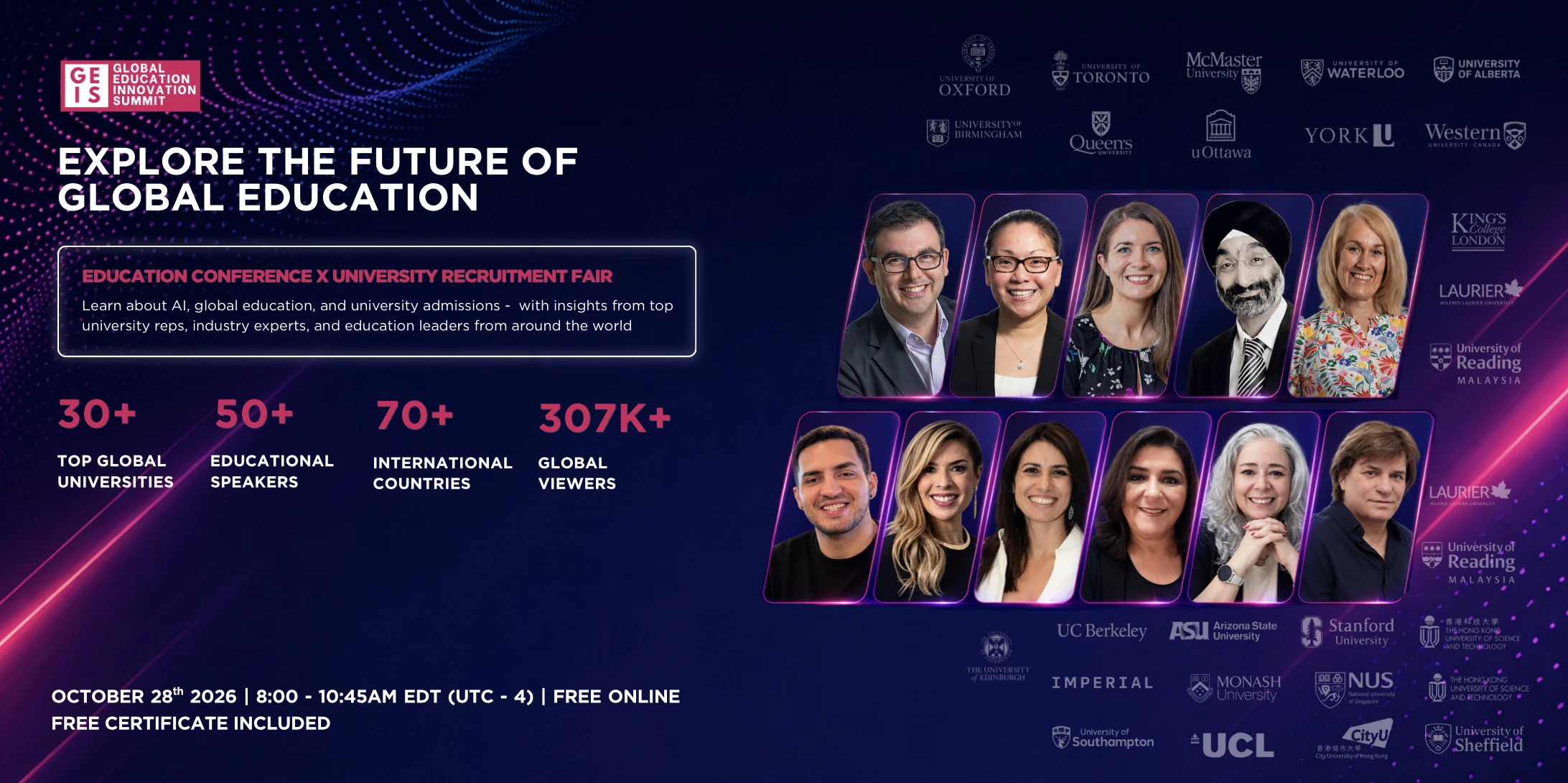
The Global Education Innovation Summit (GEIS) 2026 is a free, live virtual event hosted by Rosedale International Education on October 28, 2026. The summit brings together over 30 speakers and 40 university partners from institutions including Oxford, Imperial College London, University of Toronto, and the National University of Singapore. GEIS 2026 features interactive sessions on AI in education, global admissions, K-12 to higher education pathways, and innovation in educational technology.
Who should attend GEIS 2026?
GEIS 2026 is designed for educators, school administrators, academic directors, parents, students, and EdTech professionals. Whether you are looking to stay ahead of AI trends in education, explore partnership opportunities with global institutions, or understand how AI is reshaping student learning, the summit offers practical insights and networking opportunities for all stakeholders in the education ecosystem.
Join the Conversation at the Global Education Innovation Summit 2026
The integration of AI in teaching is not a trend that will pass. It is a fundamental shift in how education is designed, delivered, and experienced. For school owners, academic leaders, and parents who want to stay ahead of this transformation, the opportunity to learn from global experts has never been more accessible.
The Global Education Innovation Summit (GEIS) 2026, hosted by Rosedale International Education on October 28, 2026, is a free virtual event that brings together education leaders, AI innovators, and university representatives from over 72 countries. With more than 43 interactive sessions covering AI in education, global admissions, and the future of K-12 learning, GEIS 2026 offers the insights and connections that education professionals need to lead with confidence in an AI-driven world.
Featured sessions include fireside chats with AI specialists from Arizona State University, JISC UK, and the Utah State Board of Education, as well as panel discussions on student readiness, employability, and the evolving role of technology in the global classroom. Attendees also receive a free certificate of participation.
Whether you are a school owner exploring international curriculum solutions, a teacher seeking professional development in AI literacy, or a parent looking for the best educational opportunities for your child, GEIS 2026 is the place to be.
Register for free today at geisummit.com and discover how AI is shaping the future of education.