

The international education landscape is undergoing a fundamental transformation. From shifting student demographics and AI-powered screening tools to tightening visa regulations across major study destinations, the way schools recruit and enrol students from around the world is changing at an unprecedented pace.
For school owners, academic directors, and admissions leaders, understanding these global admissions trends is no longer optional. It is a strategic necessity. The institutions that adapt to this new reality will attract a broader, more qualified student body. Those that do not risk falling behind.
This article examines the key forces reshaping international admissions trends in 2026 and highlights why events like the Global Education Innovation Summit (GEIS) 2026 are essential for educators who want to stay ahead of the curve.
Shifting Demographics and Rising Demand From Non-Traditional Markets
For years, international school admissions have been dominated by a handful of source markets. China, India, and South Korea collectively accounted for the bulk of cross-border student movement. But that picture is rapidly evolving.
According to ISC Research, the global international schools sector grew by 2% year-over-year in 2026, reaching more than 15,000 schools worldwide. What is perhaps more significant is that this growth is no longer fuelled primarily by expatriate families. Local demand from families seeking globally recognised curricula has become the primary driver, with over 78% of international schools now following hybrid models that blend local educational requirements with international standards.
At the higher education level, traditional student flows are being redistributed. QS Global Student Flows data shows that the two largest source markets for the United States accounted for roughly 51% of international student numbers in 2023, but that share fell to 47% by 2026. Meanwhile, emerging markets like Nepal, Vietnam, Ghana, Bangladesh, and Pakistan are registering impressive growth. Ghana alone recorded a three-year compound annual growth rate of 22.3% in outbound student mobility.
The takeaway for international schools and their admissions teams is clear. Student recruitment trends 2026 are being shaped by a broader, more geographically diverse pool of candidates. Schools that have historically relied on a narrow set of feeder markets will need to rethink their outreach strategies. Building partnerships and brand visibility in Sub-Saharan Africa, South Asia, and Southeast Asia is becoming a competitive advantage, not just an aspiration.
This diversification also means that schools need to become more culturally responsive in their admissions processes. A one-size-fits-all enrolment experience no longer resonates with families in markets where education systems, expectations, and communication styles vary widely.
Technology-Driven Admissions: AI Screening, Virtual Interviews, and Digital Portfolios
Technology is transforming every stage of the admissions funnel. What used to be a paper-heavy, schedule-dependent process is becoming faster, more scalable, and increasingly data-driven.
AI-powered application screening is leading this shift. Institutions using AI-driven admissions tools now report significant reductions in screening workloads, with some achieving processing cycles that are up to three times faster than traditional methods. These platforms can automatically verify documents, pre-screen candidates against programme-specific criteria, and flag the most promising applicants before a human reviewer even gets involved.
Virtual interviews are another major development. AI-led interview platforms allow schools and universities to conduct structured, asynchronous video interviews with thousands of candidates simultaneously. This is a game-changer for international admissions, where scheduling across multiple time zones and managing travel logistics have traditionally been major obstacles. Students can complete their interviews at their convenience from any device, while admissions teams receive standardised scorecards and detailed analytics. The AI handles the initial evaluation; the final decision stays with the human team.
These tools are particularly valuable for institutions receiving applications from across South Asia, the Middle East, and Africa, where traditional panel-based interviews simply cannot scale to meet the volume of applicants. AI interview platforms now support assessments in more than 30 languages, making the process more inclusive and accessible for non-native English speakers.
Digital portfolios are also gaining traction. According to NACAC’s State of College Admission report, approximately 40% of surveyed institutions assign at least some weight to student portfolios in their admissions decisions. Digital portfolios allow students to showcase competencies that transcripts alone cannot capture, including critical thinking, creativity, leadership, and real-world problem-solving. For international school students competing in a crowded applicant pool, a well-curated portfolio can make the difference.
The implication for school leaders is significant. Schools that integrate technology into their admissions workflows are not just improving efficiency. They are positioning themselves as modern, forward-thinking institutions that appeal to a tech-savvy generation of students and parents.
Policy and Regulatory Changes Affecting Cross-Border Student Mobility
If shifting demographics and new technology are pulling international education forward, policy and regulatory changes are applying the brakes in some of the world’s most popular study destinations.
The United States, the United Kingdom, Canada, and Australia have all tightened their student visa frameworks in 2026. In the US, a rule published by the Department of Homeland Security in July 2026 eliminated the long-standing Duration of Status system for F and J visa holders, replacing it with a fixed four-year admission period. The rule also introduced new restrictions on academic mobility for first-year international students and reduced post-completion grace periods from 60 to 30 days.
The effects are already visible in global education admissions data. According to the IIE Spring Snapshot, nearly 60% of responding US colleges reported a decrease in international applications for the 2026-27 cycle, while only 14% reported increases. A decline in Indian student demand was identified as a leading factor.
The UK has similarly tightened its environment. Student visa application fees rose to £558 in April 2026, and the Graduate Route post-study work visa is being cut from two years to 18 months for most graduates applying from January 2027 onward. In Canada, enrolment caps have continued to reduce international student intake. Australia set a national planning level of 295,000 international student places for 2026 and raised its student visa application charge to AUD 2,500.
The ApplyBoard Trends Report 2026 captures the sentiment well: volatile policy environments and new economic realities have reshaped both the scale and direction of student mobility. Destinations that provide consistent and transparent visa systems are likely to attract the next wave of globally mobile learners.
For international schools, this policy landscape creates both challenges and opportunities. Schools positioned in or partnered with destinations that maintain stable, welcoming immigration frameworks will have a distinct advantage in recruitment. At the same time, school leaders need to keep their communities informed about how these regulatory changes affect university pathways for their graduates.
Frequently Asked Questions
What are global admissions trends?
Global admissions trends refer to the evolving patterns, strategies, and technologies that shape how international schools and universities recruit, evaluate, and enrol students from around the world. In 2026, these trends include the rise of AI-driven screening, diversification of student source markets, and the impact of visa policy changes on cross-border student mobility.
How is AI changing the international admissions process?
AI is being used across multiple stages of the admissions funnel, from automated document verification and application screening to virtual video interviews conducted asynchronously. These tools allow institutions to process larger volumes of applications more efficiently while reducing unconscious bias in candidate evaluation.
Which new student markets are growing the fastest in 2026?
Emerging markets in Sub-Saharan Africa, South Asia, and Southeast Asia are showing the strongest growth. Countries including Ghana, Nepal, Vietnam, Bangladesh, and Pakistan are contributing an increasing share of internationally mobile students, creating new opportunities for schools that broaden their recruitment strategies.
How do visa policy changes affect international school enrolment?
Tightening visa regulations in destinations such as the United States, the United Kingdom, Canada, and Australia are redirecting student flows and influencing where families choose to send their children. Schools that align with destinations offering stable and transparent immigration pathways are better positioned to sustain enrolment growth.
What is the Global Education Innovation Summit (GEIS) 2026?
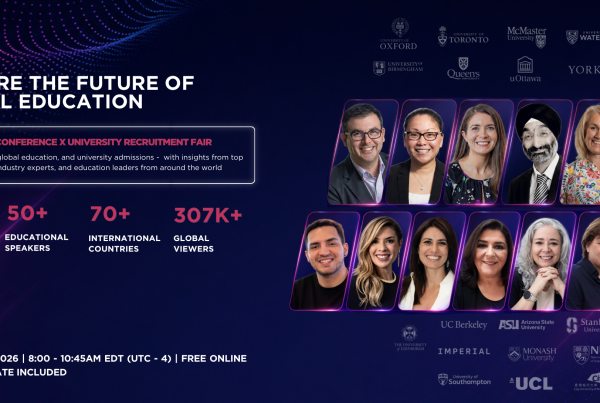
The Global Education Innovation Summit 2026 is a free, live virtual event hosted by Rosedale International Education on October 28, 2026. The summit brings together more than 30 speakers and 40 world-class university partners to explore topics including AI in education, global admissions, K-12 to higher education pathways, and innovation in the classroom. It is designed for school leaders, educators, parents, students, and EdTech professionals from over 72 countries.
The Future of Global Admissions Starts With the Right Conversations
Global admissions trends are not changing gradually. They are accelerating. From the emergence of new student source markets and the rise of AI-powered screening to the policy shifts that are reshaping cross-border mobility, every aspect of the international enrolment process is in flux.
For school owners and admissions leaders, staying informed is the first step. But true strategic advantage comes from engaging with the educators, university partners, and thought leaders who are navigating these changes in real time.
That is exactly what the Global Education Innovation Summit (GEIS) 2026 is designed to deliver. Hosted by Rosedale International Education on October 28, 2026, this free virtual summit connects school leaders, academic directors, parents, students, and EdTech innovators from more than 72 countries with over 30 world-class speakers and 40 leading university partners, including Imperial College London, the University of Toronto, Oxford University, and the National University of Singapore.
Whether you are looking to modernise your admissions strategy, explore new student recruitment channels, or simply understand where international education is heading next, GEIS 2026 offers a front-row seat to the conversations that matter.
Register for free today and join the global education community at GEIS 2026.