
The way students enter international schools is changing. What once relied on local walk-in enquiries and paper forms has grown into a cross-border operation spanning dozens of countries, multiple curricula, and families who compare schools on different continents before committing.
This shift has a name: global admissions.
For school owners evaluating how to attract and retain students, and for parents navigating an increasingly complex enrolment landscape, understanding global admissions is no longer optional. It is the foundation of how modern international education operates.
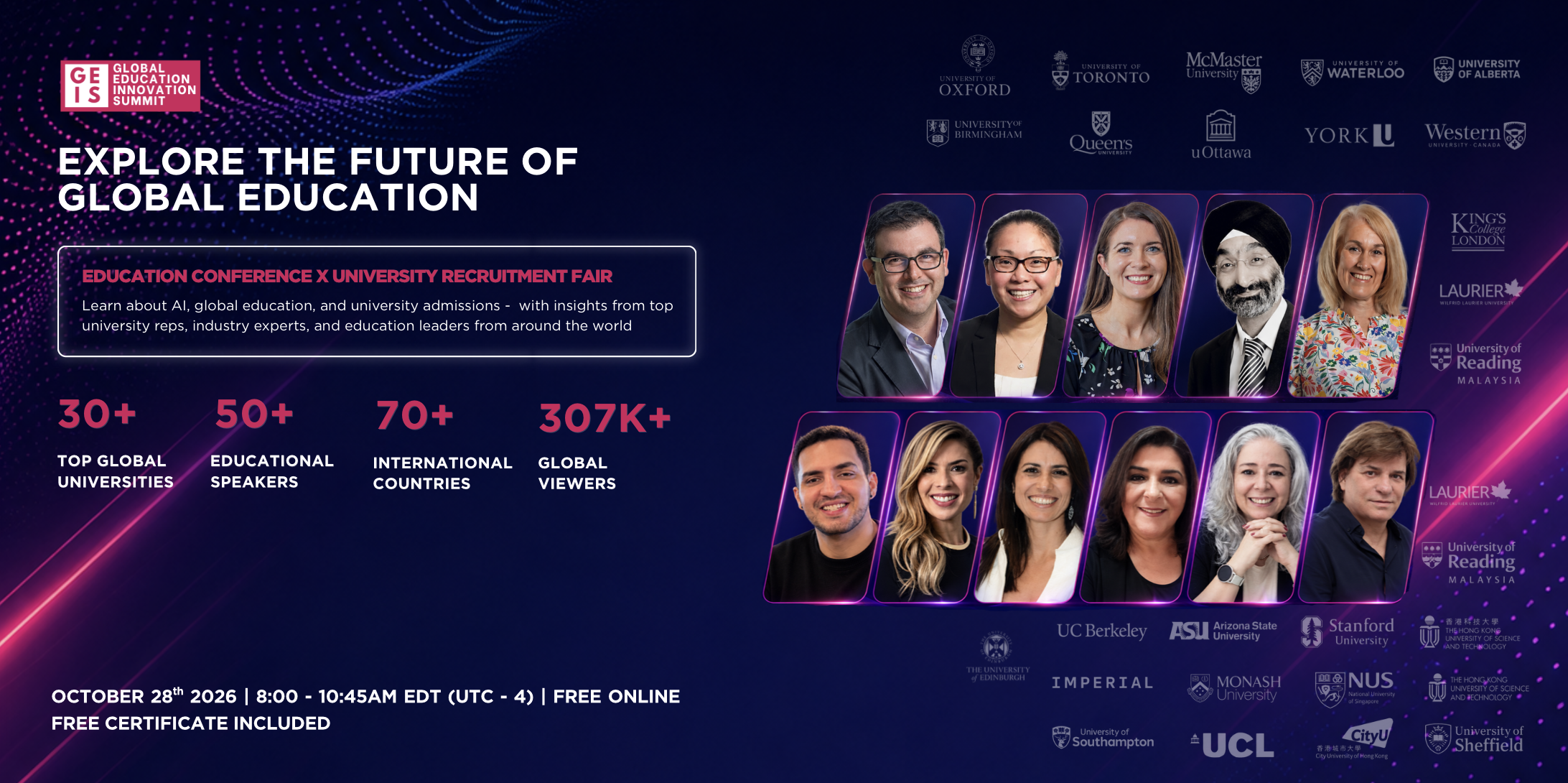
In this article, we break down the global admissions meaning, explore why the international school admissions process is evolving, and explain what a well-designed admissions framework looks like from application to onboarding. We also introduce the Global Education Innovation Summit (GEIS) 2026, where education leaders, university representatives, and families will explore these themes together on October 28, 2026.
Defining Global Admissions: Scope, Stakeholders, and How It Differs From Traditional Enrolment
At its core, global admissions refers to the systems, strategies, and processes that international schools and education providers use to recruit, evaluate, and enrol students from multiple countries and educational backgrounds. Unlike traditional enrolment, which typically serves a local or regional population within a single curriculum framework, global admissions operates across borders, time zones, and regulatory environments.
The scope of global admissions extends well beyond accepting applications. It includes aligning credential recognition across different national systems, managing multilingual communication with prospective families, and ensuring that admissions criteria reflect the diversity of applicants from around the world.
Who Are the Key Stakeholders?
Global admissions involves a wider network of stakeholders than a domestic admissions office:
- School leaders and administrators who set enrolment targets and shape the institution’s international positioning.
- Admissions teams responsible for processing applications, conducting assessments, and managing family relationships across multiple regions.
- Parents and guardians who are often comparing schools across different countries and need transparent, accessible information to make informed decisions.
- Students who may be transitioning between different curricula, languages, or educational cultures.
- University partners and accrediting bodies such as CIS, NEASC, and WASC, whose recognition standards influence how schools design their admissions policies.
How It Differs From Traditional Enrolment
Traditional enrolment is typically linear and localised. A family enquires, visits the campus, submits documents, and receives an offer. The process assumes shared language, a familiar curriculum, and geographic proximity.
Global admissions, on the other hand, must account for families applying from overseas, credential evaluation across different national systems, rolling or year-round intake cycles, and digital-first interactions where a campus visit may not be possible before acceptance. It also requires schools to consider visa and immigration documentation, financial processes in multiple currencies, and cultural expectations around communication and decision-making.
With the international school market now surpassing 15,000 schools worldwide and global student mobility projected to reach nine million by 2030, the pressure to professionalise global student enrolment has never been higher.
Why International Schools Are Moving Toward Centralised Global Admissions Models
For decades, many international schools managed admissions independently at each campus. Application forms, review processes, and communication workflows were designed locally, often with significant variation even within the same school group. As competition among international schools intensifies and applicant pools become more geographically dispersed, this fragmented approach is proving unsustainable.
Several forces are driving the shift toward centralised global admissions models.
Growing Competition in the International School Market
The international school sector has experienced remarkable growth. Since 2000, the number of international schools has increased by more than 250%, and the market now generates tens of billions in annual fee income. With more schools competing for the same pool of globally mobile families, admissions teams can no longer rely on word-of-mouth referrals or passive enquiry management. Schools need coordinated recruitment strategies and consistent applicant experiences across all touchpoints.
The Rise of Data-Driven Decision Making
Centralised admissions platforms give school leaders visibility into enrolment trends across campuses, regions, and intake cycles. Instead of waiting until after an intake period closes to understand demand, administrators can track application volume in real time, identify bottlenecks in the review process, and adjust recruitment strategies based on live data. This level of insight is nearly impossible when each campus operates its own system.
Consistency for Families
Parents comparing international schools across countries expect a coherent, professional experience. When a family applies to one campus of a global school group, they expect the same standard of communication, documentation requirements, and response times as they would at another campus. Centralised admissions ensures that the applicant experience reflects the institution’s brand and values, regardless of location.
Technology as an Enabler
The adoption of online admissions management systems has made centralisation practical. Schools that previously relied on paper-based applications and manual file-sharing among staff can now process applications digitally, track applicant status in shared dashboards, and automate communication workflows. This shift has been especially important for schools managing global student enrolment across multiple time zones, where responsiveness and coordination are critical.
The result is a more strategic, scalable approach to admissions, one that treats enrolment not as an administrative function but as a core pillar of institutional growth.
Key Components of a Global Admissions Framework: From Application to Onboarding
A well-structured international school admissions process goes far beyond collecting forms. It creates a pathway that guides families from initial awareness through to a successful first day at school. Here are the essential components of a global admissions framework.
1. Enquiry and Discovery
The process begins when a prospective family makes contact, whether through a website enquiry form, a virtual event, or a referral. At this stage, admissions teams should provide clear, accessible information about the school’s curriculum, values, fee structure, and entry requirements. For global audiences, this means offering multilingual resources, virtual campus tours, and responsive communication across time zones.
2. Application and Document Collection
Once a family decides to apply, the school collects essential documentation. This typically includes completed application forms, academic transcripts and school reports, passport or identification documents, language proficiency assessments where applicable, and recommendation letters from previous teachers or school leaders.
For international applicants, document requirements may also include translated and notarised academic records, visa-related paperwork, and health or immunisation records that meet local regulations.
3. Assessment and Interview
Most international schools conduct some form of evaluation to determine academic readiness and fit. This may involve standardised testing in English and mathematics, a personal interview with academic leadership, and observation sessions for younger students. The assessment stage is where the international school admissions process often diverges from domestic models. Schools must be prepared to evaluate credentials from unfamiliar education systems and to identify potential in students whose backgrounds do not map neatly onto a single grading standard.
4. Offer and Acceptance
Following review, the admissions committee issues a decision. Successful applicants receive a formal offer of admission, along with details on tuition fees, payment schedules, and any conditions that must be met before enrolment is confirmed. For global families, this stage may also involve financial considerations such as multi-currency payment options and scholarship availability.
5. Pre-Arrival Onboarding
Onboarding is one of the most overlooked yet impactful stages in global student enrolment. Effective onboarding includes orientation materials that introduce the school’s culture, academic expectations, and campus life. It also covers administrative steps such as uniform ordering, technology setup, and transportation arrangements. For boarding schools or families relocating internationally, pastoral onboarding, including housing, dietary needs, and guardian appointments, is equally essential.
Schools that invest in a structured onboarding experience report smoother transitions, higher family satisfaction, and stronger retention rates in the critical first year.
Frequently Asked Questions About Global Admissions and GEIS 2026
What does global admissions mean?
Global admissions refers to the end-to-end systems and strategies that international schools and education providers use to recruit, evaluate, and enrol students from diverse countries and educational backgrounds. It goes beyond traditional local enrolment by incorporating cross-border credential recognition, multilingual communication, and digital-first application processes designed for globally mobile families.
How is the international school admissions process different from local school enrolment?
The international school admissions process typically involves additional steps that local enrolment does not require. These include evaluation of foreign academic credentials, language proficiency assessments, virtual interviews for overseas applicants, and documentation related to visas or immigration. Many international schools also offer rolling admissions to accommodate families relocating at different points in the academic year.
Why are international schools adopting centralised admissions models?
As competition grows and applicant pools become more global, schools need consistent, data-driven admissions operations. Centralised models allow school groups to maintain a unified applicant experience across campuses, track enrolment data in real time, and make strategic decisions about recruitment and capacity planning.
What is the Global Education Innovation Summit (GEIS) 2026?
GEIS 2026 is a free, live virtual summit hosted by Rosedale International Education on October 28, 2026. The event connects education leaders, AI innovators, parents, students, and universities from over 72 countries. It features 30+ global speakers, 43+ interactive sessions, and 40+ world-class university partners discussing topics including global admissions, AI in education, and the pathway from K-12 to higher education.
Who should attend GEIS 2026?
GEIS 2026 is designed for school owners, administrators, educators, parents, students, and EdTech professionals. Whether you are a school leader looking to strengthen your institution’s global admissions strategy or a parent exploring international education options for your child, the summit offers valuable insights and networking opportunities.
How do I register for GEIS 2026?
Registration is completely free. Visit geisummit.com to secure your spot. All attendees receive access to live sessions, recordings, digital resources, and a free certificate of participation.
Shape the Future of Global Admissions at GEIS 2026
Global admissions is no longer a niche concern for a handful of large school groups. It is the operating reality for any institution that serves, or aspires to serve, internationally minded families. From rethinking how applications are processed to building onboarding experiences that set students up for success, the schools that invest in a structured global admissions framework today will be the ones that thrive tomorrow.
The conversation about what comes next for global admissions is happening at the Global Education Innovation Summit 2026. Hosted by Rosedale International Education on October 28, 2026, this free virtual summit brings together 30+ speakers from institutions including Imperial College London, University of Toronto, National University of Singapore, Oxford University, and many more.
Whether you are a school owner looking to modernise your admissions strategy, an educator exploring how AI is reshaping student pathways, or a parent seeking clarity on international education options, GEIS 2026 is the place to be.
Register for free at geisummit.com and join 307,000+ global educators, parents, and students in shaping the future of education.