
Artificial intelligence is no longer a distant concept confined to research labs and technology companies. It is actively reshaping the way businesses operate, the way professionals work, and, most importantly, the way employers evaluate new talent. For students, parents, and school owners navigating the future of education, the question is no longer whether AI matters. The question is whether the university you choose will prepare graduates with the right AI workforce skills education to thrive in this rapidly evolving landscape.
A recent global study by Pearson and Amazon Web Services found that 53% of employers struggle to find graduates equipped with the right AI skills. Meanwhile, 78% of higher education leaders believe they are already meeting employer expectations, but only 28% of employers agree with that assessment. This gap between perception and reality highlights a critical challenge that universities worldwide must address.
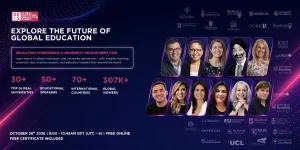
The Global Education Innovation Summit (GEIS) 2026, hosted by Rosedale International Education on October 28, 2026, brings this conversation to the forefront. The free virtual summit connects education leaders, AI innovators, parents, students, and universities from over 72 countries to explore how institutions can better prepare students for careers in the AI era. One of the featured sessions, “Student Readiness in the AI Era: From Admissions to Employability,” will address these exact challenges with panelists from Imperial College London, University of Waterloo, University College Dublin, UC Berkeley, and University of Technology Sydney.
In this article, we explore the intersection of ai and employability in education, how universities are responding to the shifting demands of the modern workforce, and what students and parents should consider when choosing an AI-ready institution.
How AI Is Changing Employer Expectations
The hiring landscape has shifted dramatically over the past two years. Employers are no longer satisfied with graduates who simply hold a degree in a relevant field. According to the CarringtonCrisp See the Future 2026 report, 77% of employers now expect new hires to have at least some hands-on experience with AI tools, yet 58% believe universities are falling short of building those capabilities. This mismatch reveals a growing tension between what higher education delivers and what the modern workplace demands.
The National Association of Colleges and Employers (NACE) reports that more than one-third of entry-level job postings now require AI-related skills. These requirements are not limited to technology or engineering roles. Financial services, marketing, analytics, and project coordination positions increasingly list AI fluency as a baseline expectation. Employers are offering, on average, a 23% wage premium for graduates who demonstrate proficiency with AI tools, a clear signal that employability skills ai era are becoming essential across every discipline.
At the same time, the durability of traditional skills is declining. Tasks that once formed the foundation of entry-level roles, such as data entry, basic research, and report drafting, are being automated at an unprecedented pace. Research from OutreachX suggests that up to 50% of entry-level positions may disappear within the next five years as AI tools continue to handle foundational tasks. For graduates, this means that arriving with only theoretical knowledge is no longer sufficient. Employers expect candidates to demonstrate applied AI competence from day one.
Perhaps the most telling statistic comes from the Pearson study: only 14% of recent graduates report using AI proficiently in their work. When nearly 54% of organizations now require AI skills for all early-career roles, this gap represents both a challenge and an opportunity for universities willing to adapt.
Work-Integrated Learning and AI-Enhanced Career Services
As the demand for university career readiness ai grows, forward-thinking institutions are integrating AI into their experiential learning programs and career services. Work-integrated learning (WIL), which combines academic study with practical workplace experience, has emerged as one of the most effective strategies for bridging the gap between classroom knowledge and employer expectations.
The University of Waterloo, one of the featured institutions at GEIS 2026, provides a compelling example. The university recently received a $500,000 grant from Embark to launch a three-year pilot program called AI-Enabled Learners. The initiative combines AI literacy training with real-world WIL experiences, allowing students to apply AI tools to genuine organizational challenges. Students complete a self-paced micro-course in AI foundations, then move into applied projects where they use AI tools to solve real problems. Upon completion, they earn a certificate of participation that they can share with potential employers.
This model reflects a broader shift in how universities approach career readiness. Rather than treating AI literacy as a standalone course, institutions are embedding it directly into co-op placements, internships, and capstone projects. The NACE survey found that nearly 60% of employers are now assigning interns projects that require AI tools and skills, creating a feedback loop where students gain practical experience while employers evaluate emerging talent.
Career services departments are also evolving. Universities are partnering with industry professionals to show students how AI is applied in real job settings, moving beyond theoretical instruction to hands-on demonstrations of workplace AI applications. The University of Florida’s Career Connections Center, for instance, coordinates AI career pathways that connect students with AI-focused internship opportunities and professional development resources regardless of their academic discipline.
These developments signal a fundamental rethinking of what career readiness means. Graduates who have used AI tools in authentic professional contexts have a clear advantage over those who have only studied them in a classroom.
University Programs That Bridge AI Literacy and Employability
Universities around the world are launching ambitious programs to ensure that ai workforce skills education is not limited to computer science departments. The most impactful initiatives share a common philosophy: AI literacy should be accessible to every student, regardless of their field of study.
The University of Florida has developed a comprehensive model called AI Across the Curriculum, which integrates AI literacy into undergraduate education across all colleges and disciplines. The program operates through four key initiatives: curriculum development that embeds AI into existing courses, new academic programs with AI-related certificate options, undergraduate scholars and medallion programs that recognize AI achievement, and career pathways that connect AI learning with professional opportunities. The model ensures that a student studying geography or history has the same opportunity to develop applied AI skills as a student in engineering or data science.
In a similar move, Middlesex University Dubai has enrolled more than 3,000 students in a university-wide AI literacy program designed to prepare graduates for a workplace increasingly shaped by artificial intelligence. The initiative goes beyond a single course, incorporating AI hackathons and upskilling sessions into the curriculum across departments.
In North America, several major institutions have mandated AI fluency requirements beginning in Fall 2026. The University of Colorado Colorado Springs, for example, has implemented a mandatory AI Literacy Foundations course that all students, faculty, and staff must complete before accessing AI tools on campus. This approach treats AI readiness as essential infrastructure rather than an optional enrichment opportunity.
Canada has also made significant strides. Led by the Alberta Machine Intelligence Institute (Amii) with support from Google, the national AI Workforce Readiness program now includes a consortium of 29 institutions representing more than 500,000 students. The program provides foundational AI literacy modules that cover responsible use, effective prompting, and critical evaluation of AI outputs.
These programs demonstrate that universities are beginning to close the gap between what employers need and what graduates can offer. The institutions that move fastest to embed AI across their curriculum will produce graduates who are not just employable, but genuinely competitive in the ai jobs for graduates market.
What Students and Parents Should Look for in an AI-Ready University
With so many institutions now claiming to offer AI-integrated education, how can students and parents separate genuine AI readiness from marketing language? Here are the key indicators that distinguish a truly AI-ready university from one that is simply following the trend.
First, look for institutions that embed AI across the entire curriculum rather than confining it to a single department. A university that offers AI literacy only through its computer science faculty is providing a limited experience. The best programs integrate AI tools and concepts into business, humanities, social sciences, healthcare, and the arts, ensuring that every graduate leaves with applicable skills.
Second, evaluate the presence of work-integrated learning opportunities that include AI applications. Co-op programs, industry partnerships, and capstone projects that require students to use AI tools in authentic professional settings are far more valuable than theoretical coursework alone. Universities like Waterloo and UF have demonstrated that hands-on AI experience is what gives graduates a competitive edge in the hiring process.
Third, consider the university’s partnerships with industry and technology leaders. Institutions that collaborate with employers to design their AI curriculum are more likely to produce graduates whose skills align with actual workforce needs. The Pearson AI Readiness Friction Framework identifies “education-employer alignment” as one of the six structural friction points that universities must address to improve graduate readiness.
Fourth, assess the institution’s approach to ethical AI education. The ASEE Conference on employer perspectives in 2026 highlighted that employers increasingly prioritize graduates who understand AI limitations, ethical implications, and responsible use. Technical fluency alone is not enough. Graduates must also demonstrate adaptive thinking, critical reasoning, and the ability to evaluate when and how AI should be applied.
Finally, attend events like the Global Education Innovation Summit 2026, where university representatives from leading institutions worldwide share their strategies for AI integration and student readiness. Events like GEIS provide a direct line to admissions officers, academic leaders, and AI education experts who can help families make informed decisions.
Frequently Asked Questions
Why is AI and employability in education important right now?
AI is fundamentally changing the skills that employers value. With more than half of employers reporting difficulty finding AI-ready graduates and a growing number of entry-level roles requiring AI proficiency, universities must adapt their curricula to ensure that graduates are prepared for the modern workforce. Students who develop employability skills ai era will have a significant advantage in the job market.
What are the most in-demand AI workforce skills for graduates?
Employers are looking for graduates who can use AI tools effectively in practical settings, not just those who understand the theory behind them. Key skills include prompt engineering, data analysis using AI platforms, ethical AI reasoning, AI-assisted content creation, and the ability to evaluate and improve AI outputs. Equally important are complementary human skills such as critical thinking, communication, adaptability, and collaborative problem-solving.
How can parents evaluate whether a university truly prepares students for AI jobs?
Parents should look beyond marketing claims and examine whether the university integrates AI across all disciplines, offers work-integrated learning experiences with AI components, maintains active partnerships with industry employers, and provides dedicated AI career pathways. Attending events such as the Global Education Innovation Summit 2026 is also an excellent way to hear directly from university leaders about their AI readiness strategies.
What is the Global Education Innovation Summit 2026?
The Global Education Innovation Summit (GEIS) 2026 is a free live virtual event hosted by Rosedale International Education on October 28, 2026. The summit features over 30 speakers and more than 40 world-class university partners from institutions including Imperial College London, University of Toronto, National University of Singapore, UC Berkeley, and Arizona State University. GEIS 2026 explores AI in education, global admissions strategies, and the future of student readiness in the AI era. Registration is free at geisummit.com.
Who should attend GEIS 2026?
GEIS 2026 is designed for school owners, education professionals, parents, students, and anyone interested in the future of global education. School leaders can discover strategies for institutional transformation and AI integration. Parents and students can connect directly with university representatives, learn about admissions trends and scholarships, and understand how AI is reshaping education and career pathways.
Prepare for the AI Workforce: Join GEIS 2026
The relationship between ai and employability in education is evolving at a pace that no institution can afford to ignore. Universities that invest in cross-disciplinary AI literacy, work-integrated learning, and strong industry partnerships will produce graduates who are ready to contribute from their first day in the workforce. For students and parents, understanding these shifts is essential to making informed decisions about higher education.
The Global Education Innovation Summit 2026 offers a unique opportunity to explore these topics with the educators, researchers, and institutional leaders who are driving change. With over 30 speakers from world-class universities, interactive panel discussions on student readiness in the AI era, and direct access to admissions representatives from more than 40 global institutions, GEIS 2026 is the premier event for anyone who wants to understand how AI is transforming the journey from school to career.
Hosted by Rosedale International Education, the summit takes place on October 28, 2026, as a free live virtual event with sessions broadcast from 08:00 to 10:45 AM EDT. All registered attendees receive a free certificate of participation and access to session recordings after the event.
Whether you are a school owner exploring AI curriculum integration, a parent researching the best universities for your child, or a student preparing for ai jobs for graduates in 2027 and beyond, GEIS 2026 has something for you.
Register for free today at geisummit.com and take the first step toward understanding how the world’s leading universities are preparing the next generation for an AI-powered future.